
If you’re a founder staring at a blank LinkedIn post publishing page, you don’t need better ideas, motivation or more focus. You just need a repeatable system that turns your daily operations into content. Below are 30 ideas grouped into six categories, each with a simple template you can fill in today. The best founder content comes from what you already know: your lessons, opinions, stories, and the reality of building your company. Pick one, add your experience into it, and hit publish
Save this list and return to it whenever you’re stuck. Rotating across the categories also keeps your feed varied, which keeps your audience engaged.
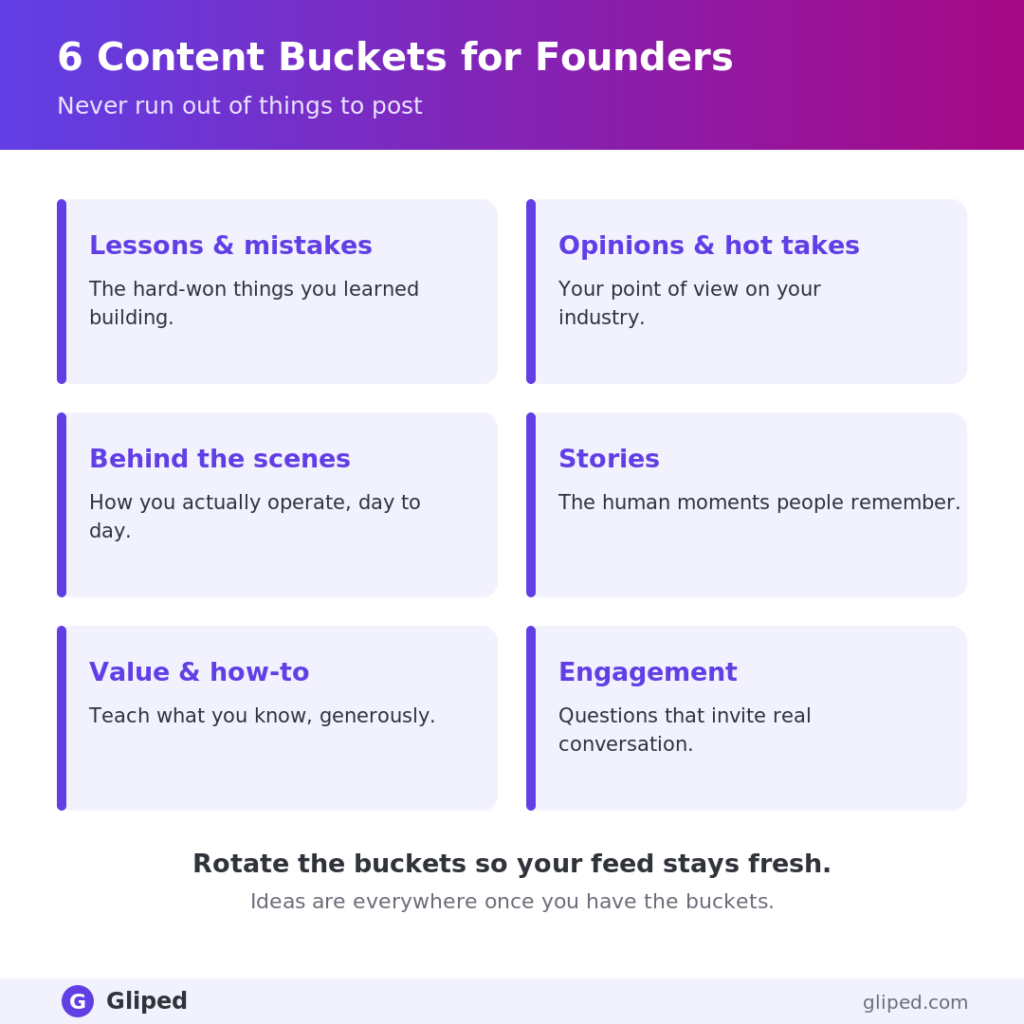
Lessons and mistakes (your hard-won experience)
These perform because they trade in first-hand experience — exactly what readers trust and what the algorithm rewards.
- The biggest mistake you made in year one and what it taught you. Template: ‘In our first year I [mistake]. It cost us [X]. Here’s what I’d do differently.’
- A decision you were sure about that turned out wrong. Template: ‘I was convinced [belief]. I was wrong. Here’s what changed my mind.’
- A lesson that took you years to learn. Template: ‘It took me [X] years to understand this: [lesson].’
- Advice you’d give your younger founder self. Template: ‘If I could tell the 25-year-old me one thing about building a company: [advice].’
- Something you believed early that you’ve since abandoned. Template: ‘I used to think [X]. Now I think [Y]. Here’s why.’
Opinions and hot takes (your point of view)
Safe takes don’t build audiences. Defend a bold perspective to attract the people who actually align with your vision.
- A common piece of advice in your industry that you think is wrong. Template: ‘Everyone says [advice]. I disagree, and here’s why.’
- A trend you think is overhyped. Template: ‘Unpopular opinion: [trend] is overrated for most [audience].’
- A contrarian prediction about where your industry is heading. Template: ‘In [X] years, I think [prediction]. Most people disagree.’
- A ‘sacred cow’ in your field worth questioning. Template: ‘We treat [practice] as gospel. Should we?’
- What you’d change about how your industry works. Template: ‘If I could fix one thing about [industry], it would be [X].’
Behind the scenes (how you actually operate)
People are endlessly curious about how things really work. Pull back the curtain.
- A hard decision you made recently and how you thought about it. Template: ‘Last month we had to decide [X]. Here’s how we thought it through.’
- How you hire, and what you actually look for. Template: ‘The one thing I look for in every hire: [trait]. Here’s why.’
- A number from your business and the story behind it. Template: ‘We just hit [metric]. Here’s the unglamorous story of how.’
- A day in your life as a founder. Template: ‘What running [company] actually looks like on a Tuesday.’
- A tool, habit, or system that changed how you work. Template: ‘This one change saved me [X] hours a week: [system].’
Stories (the human moments)
Stories are how people remember you. Each should carry a professional point.
- The moment you decided to start your company. Template: ‘The exact moment I knew I had to build [company].’
- A near-failure and how you got through it. Template: ‘Two years ago we almost didn’t make payroll. Here’s what happened.’
- A customer moment that reminded you why you do this. Template: ‘A customer said something last week that stopped me in my tracks.’
- A mentor or person who changed your trajectory. Template: ‘One conversation changed the course of my career. Here it is.’
- A time you got lucky and what you learned about luck. Template: ‘People call it luck. Here’s what actually happened.’
Value and how-to (teach what you know)
Genuinely useful posts get saved and shared — both strong signals.
- A step-by-step for something you’re good at. Template: ‘How we [achieve outcome], in [X] steps.’
- A framework you use to make a common decision. Template: ‘The simple framework I use to decide [X].’
- A myth in your field, debunked. Template: ‘The myth: [X]. The reality: [Y].’
- A list of resources or tools you’d recommend. Template: ‘The [X] tools I’d rebuild my company with tomorrow.’
- An explainer of something your audience finds confusing. Template: ‘[Confusing topic], explained simply.’
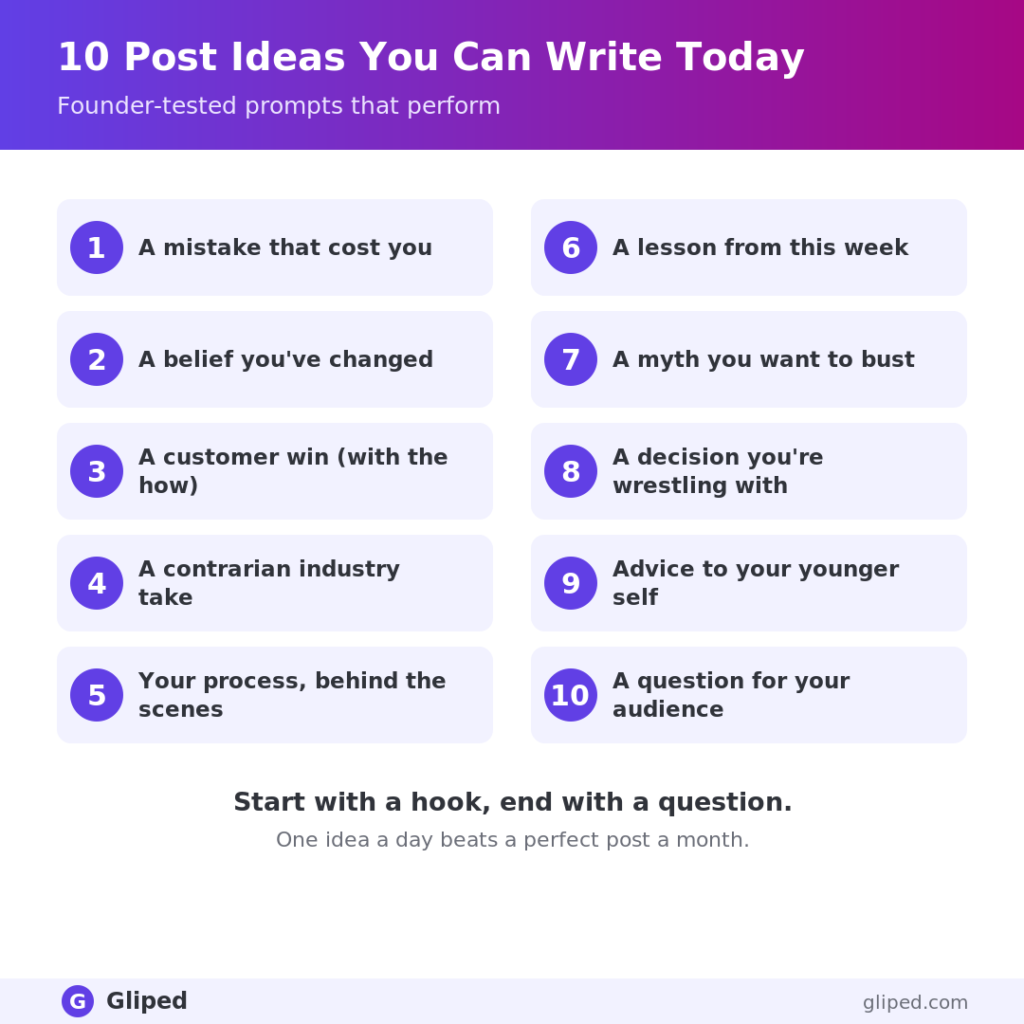
Engagement and community (invite the conversation)
Use these sparingly, and make them genuine questions rather than bait.
- A real question you’re wrestling with. Template: ‘Genuine question for other founders: how do you handle [X]?’
- Ask your audience for their take on a decision. Template: ‘We’re deciding between [A] and [B]. What would you do?’
- Celebrate someone else and tag them. Template: ‘Want to give credit to [person] for [thing].’
- Share a resource and ask what to add. Template: ‘Here’s my list of [X]. What am I missing?’
- A poll on a live debate in your industry. Template: ‘Quick poll: [question] — curious what you’d pick.’
How to make any of these perform
An idea is only the start. Open with a hook strong enough to stop the scroll, keep paragraphs short and scannable so people actually read (dwell time is a top ranking signal), and end with something that invites a comment rather than a like. Keep external links out of the post body. Post when your audience is active, and reply to early comments to extend the conversation. Rotate across the six categories so you never sound redundant. Do that consistently and the blank page stops being a problem while your presence starts compounding.
Where Gliped comes in
If you’d rather never stare at a blank page again, we’ve got you.
Founded by Prabal Lakhotiya — a LinkedIn Top Voice for personal branding — we’ve used these same organic strategies to help 200+ founders and executives and 15+ brands grow on LinkedIn, with most seeing real traction within two to three months. No ads and no follower-buying — just sharp positioning, content in your own voice, and the consistency that compounds. Along the way, we’ve worked with executives from companies like Meta, Amazon Web Services, McDonald’s, Marubeni, Piramal Finance, Education First, BT Group and Urbanic — helping the person behind the brand, not just the logo.
If you’d like this handled for you, see how we work at gliped.com or reach out for a quick, no-pressure chat — we’ll tell you honestly whether we’re the right fit.