
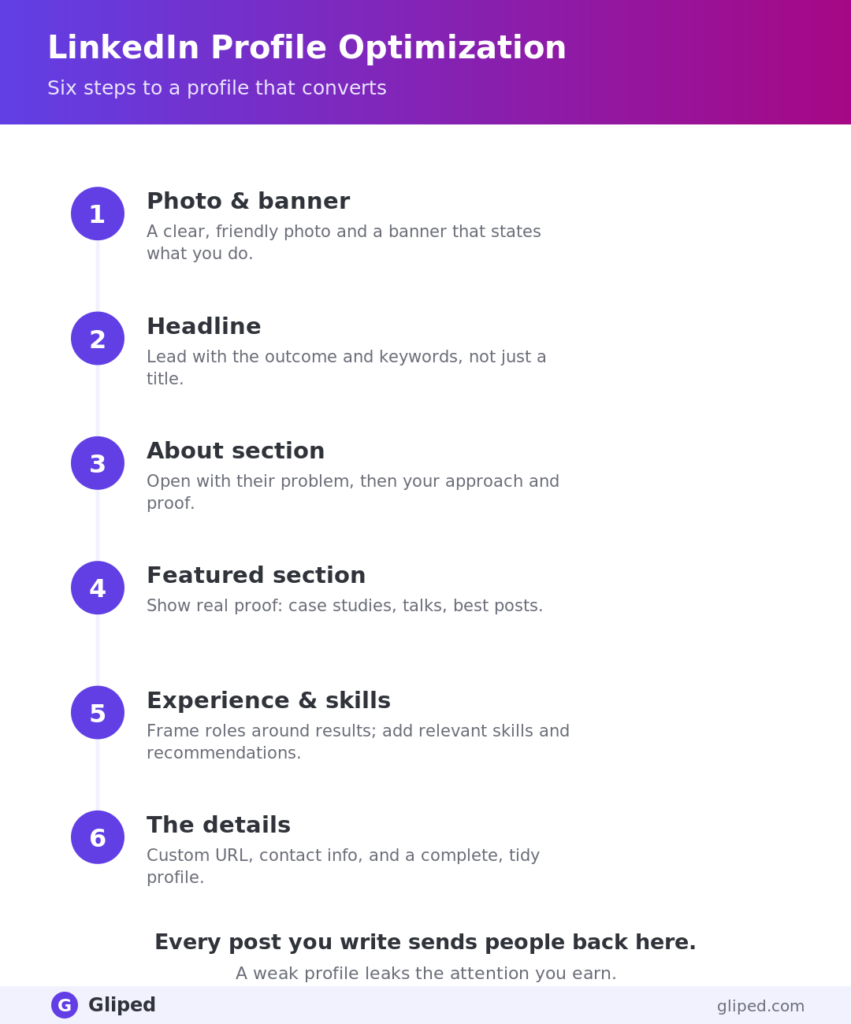
To optimize your LinkedIn profile in 2026, work through it top to bottom with one goal in mind: make it instantly clear who you help, how, and why you can be trusted.
- A clear photo
- A keyword-rich headline
- A first-person About section that hooks your ideal reader
- A featured section that proves your value.
- A thoroughly updated Experience and Skills section.
Do these 5 things and you’ll be found more in searches and convert far more of the people who land on your page.
Your profile is your landing page. When your content, a search, or an introduction directs someone to your profile, this is where they decide whether to follow, connect, or reach out. A complete, well-tuned profile is many times more likely to be discovered by the right people — so let’s optimize each part in order.
Why does LinkedIn profile optimization matter?
Two audiences read your profile: humans and LinkedIn’s search algorithm. Humans decide in seconds whether you’re worth their time. The algorithm decides whether to suggest you at all when someone searches for what you do. Optimization serves both — clarity and proof for people, keywords and completeness for search. Profiles that are completely filled out and keyword-aligned earn significantly more views and are more likely to appear when a prospective client or recruiter is searching.
Step 1: Nail your photo and banner
Step 2: Write a headline that gets you found
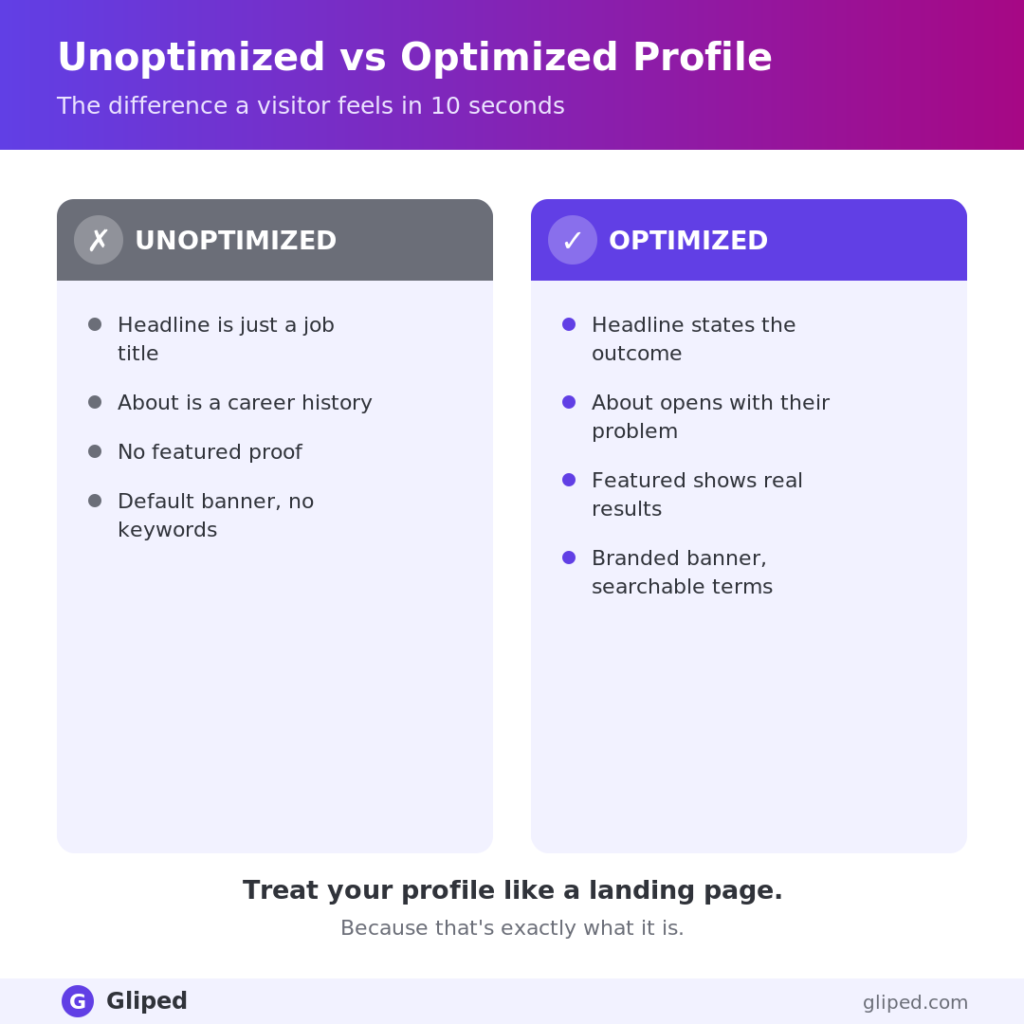
Your headline is the most heavily weighted field on your profile for both search and first impressions. Skip the generic job title. Use the formula: who you help + the outcome you create + a credibility signal, and weave in four or five keywords what your audience actually searches for. “Founder | Helping B2B SaaS teams turn LinkedIn into pipeline | ex-[Company]” A headline like this tells the right person everything in one line. For a deep dive and dozens of examples across roles, see our complete guide on LinkedIn headlines.
Step 3: Turn your About section into a client magnet
Most About sections are dry, cluttered job summaries. Make sure you sound like a person talking.
Open with a hook aimed at your ideal reader — the problem you solve or a sharp statement of what you do
Explain how you help and who you help, and close with a clear next step (how to work with you or reach you).
Write in the first person, keep paragraphs short and scannable, and include the keywords you want to rank for.
Now this looks like a career story with a purpose, not a résumé.
Step 4: Use the Featured section as proof
Step 5: Complete Experience, Skills, and Recommendations
Fill out your Experience so each role reinforces your positioning — describe outcomes and impact, not just duties and mirror the language your audience uses.
Add the skills that matter most to how you want to be found, since skills feed search too.
Then gather Recommendations: Specific, genuine ones from clients or colleagues look far more credible and persuasive than anything you write about yourself. They’re also a major E-E-A-T and trust signal for both people and Google.
Step 6: Skip the details that quietly cost you
A few small things make a profile look polished and credible. Claim your custom URL (linkedin.com/in/yourname) so it’s clean to share. Make sure your contact info and website are current. Turn on Creator mode if you post regularly, and add relevant featured topics. Finally, read the whole profile end to end as if you were your ideal client — anything vague, outdated, or off-message is worth fixing.
How long does profile optimization take?
A focused pass takes an afternoon, and it’s the highest-return hour you’ll spend on LinkedIn. Optimization isn’t a one-time task, though — revisit your headline and About whenever your focus shifts, and refresh your Featured section as you create better content. A profile is a living asset: keep it aligned with what you want to be known for, and it keeps working for you around the clock.
Once your profile converts, the next lever is consistent content that sends the right people to it. That’s where a full personal-branding practice or help sustaining it comes in.
Where Gliped comes in
Want your profile optimised by people who do this every day?
That’s what we do at Gliped. Founded by Prabal Lakhotiya — a LinkedIn Top Voice for personal branding — we’ve used these same organic strategies to help 200+ founders and executives and 15+ brands grow on LinkedIn, with most seeing real traction within two to three months. No ads and no follower-buying — just sharp positioning, content in your own voice, and the consistency that compounds. Along the way, we’ve worked with executives from companies like Meta, Amazon Web Services, McDonald’s, Marubeni, Piramal Finance, Education First, BT Group and Urbanic — helping the person behind the brand, not just the logo.
If you’d like this handled for you, see how we work at gliped.com or reach out for a quick, no-pressure chat — we’ll tell you honestly whether we’re the right fit.