
Nobody trusts a logo. They trust a person. That’s the whole reason personal branding for CEOs drives revenue — when a founder shows up with a clear, credible voice on LinkedIn, buyers decide they trust the company before the first call ever happens. Sales cycles shorten. Inbound leads show up. Talent, investors, and press start coming to you. On a platform where four out of five members influence business decisions, your voice as a founder is one of the highest-leverage assets your company owns. And most founders leave it sitting idle.
If you’ve quietly filed LinkedIn under “vanity,” this is the argument for why it’s actually a revenue channel — plus what to post and how to make it work when your calendar is already full.
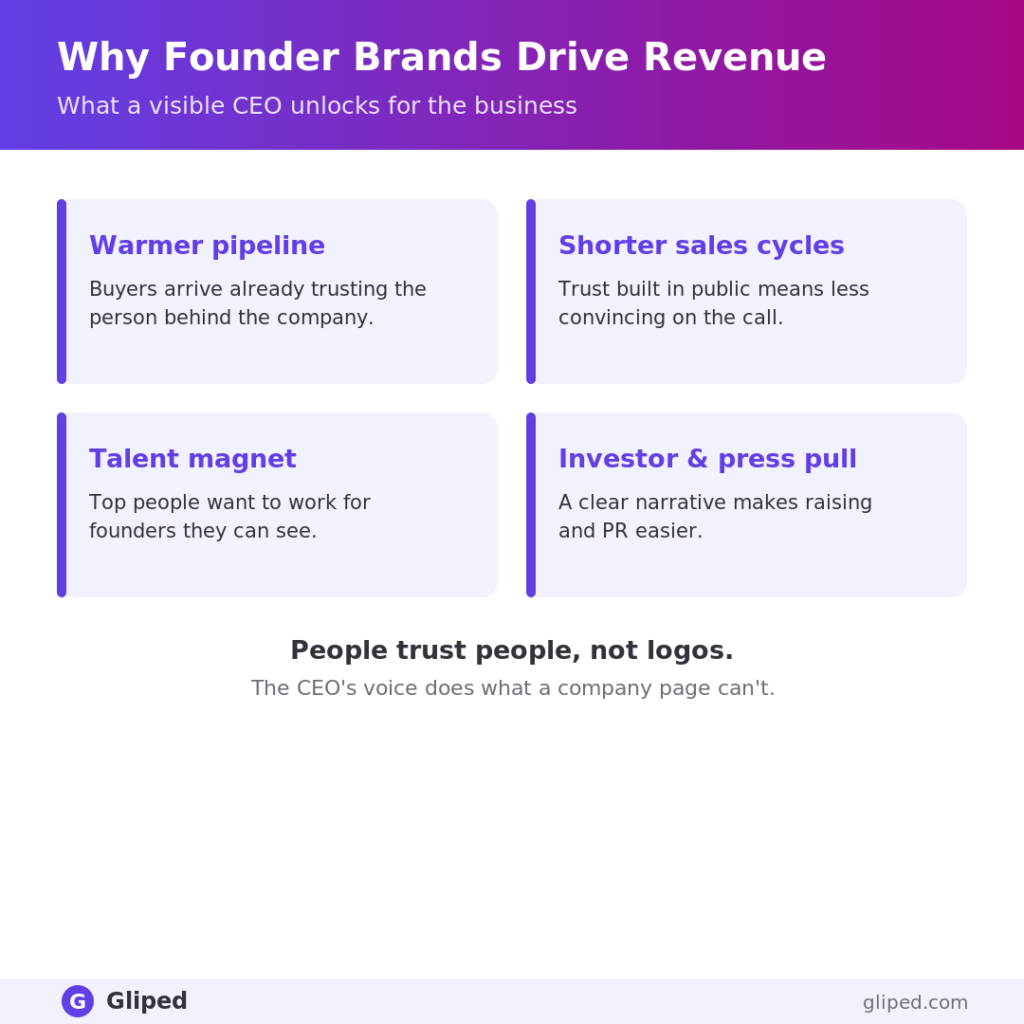
Why do founder brands actually drive revenue?
Here’s what changed. Buyers research you before they ever talk to you. They Google your name, they open your profile, they read what you’ve said. A founder with a real presence gives them a reason to trust the business before anyone picks up the phone. And that trust doesn’t stay in one place — it leaks into every corner of the company.
- Shorter sales cycles: prospects who already follow you walk into the call warm. Half the selling is done.
- Inbound leads: post something genuinely useful, consistently, and the exact buyers you want start finding you.
- Talent: the best people want to work for leaders they respect. A visible founder makes hiring easier and cheaper.
- Investors and partners: money and partnerships flow toward founders with a credible public track record.
- Media and speaking: a strong presence pulls in journalists, podcasts, and stages — reach you didn’t pay for.
A thought worth considering: spending on building your own executives’ brands is usually far better value than a big paid or celebrity budget. Why? Because the audience you build is yours. It’s targeted. And it keeps working long after any campaign ends.
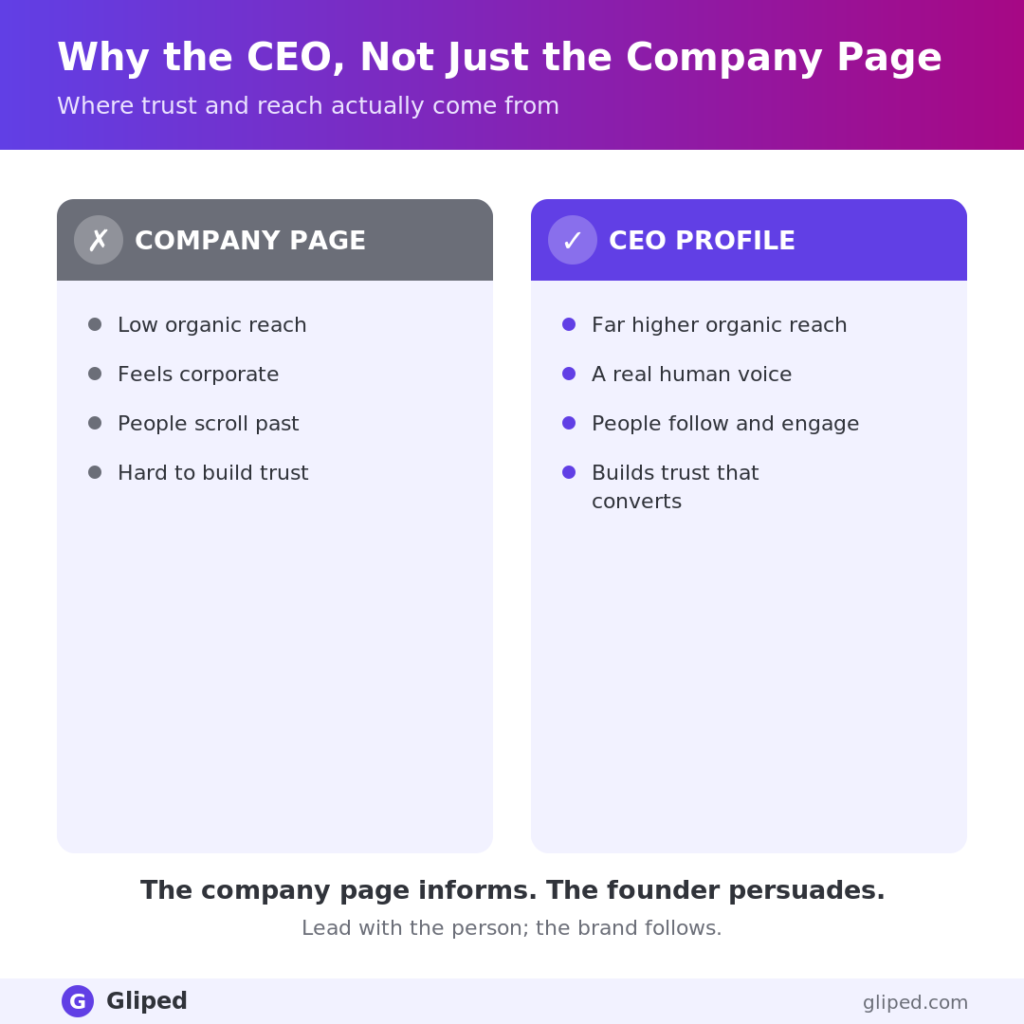
Why the CEO — and not just the company page?
Because company pages get a fraction of the reach and almost none of the trust. People scroll past brand posts. They stop for human ones. A founder sharing a hard lesson, a contrarian take, or a behind-the-scenes moment earns attention a logo never will. Your face and your voice carry something marketing copy simply can’t fake. That’s not an opinion — it’s why founder-led content consistently outperforms brand content on LinkedIn, every single time.
As a CEO what to post about on LinkedIn?
This is the wall most executives hit: “I don’t know what to say.” Here’s the truth — you’re sitting on a goldmine and calling it empty. The strongest founder content comes straight from what you already know.
- Lessons from building the company — the decisions, the mistakes, the turning points only you lived through.
- Where you think your industry is heading, especially where you disagree with everyone else.
- How you actually operate — culture, hiring, the hard calls, the bets.
- Market insight you’ve earned firsthand that your buyers would genuinely find useful.
- The occasional personal story with a real point — the human stuff that makes people root for you.
The thread running through all of it is first-hand experience. That’s what earns trust with readers. And increasingly, it’s what Google’s E-E-A-T standards and AI engines reward when they decide whose voice to surface. If you want thought leadership content, you have to contribute actual thoughts. AI can write a decent generic post — but every third person in your industry is already posting the same AI-generated take with slight variations. Your inputs are what make a post sound like you instead of like everyone.
"I don't have time" — so how does this really work?
Let’s be honest about the real obstacle. It was never ideas or ability. It’s time and consistency. Personal branding rewards showing up week after week for months, and that’s exactly what running a company makes hard. There are three realistic ways through it. Block a focused hour a week and defend it like a meeting with your biggest client. Record voice notes between meetings and have someone shape them into posts. Or handover the craft and consistency to a ghostwriter or agency who captures your thinking and turns it into a steady presence, the same reason CEOs have speechwriters.
Whichever route you pick, the model is identical: your thinking is the raw material, and the job is getting it in front of the right people, consistently. If the outsourcing route interests you, our guides on how ghostwriting works and what an agency costs lay out exactly what to expect.
The part nobody has patience for: compounding
Founder branding is a long game with an outsized payoff, and the first month feels like shouting into an empty room. That’s where most people quit. But a year of consistent, well-positioned presence turns your name into an asset that generates inbound interest, warms up sales, pulls in talent, and opens doors — without a matching jump in spend. In a market where trust is the scarcest thing going, the founders who are visible and credible take a disproportionate share of it. So personal branding for CEOs isn’t vanity. It’s one of the best-returning bets a leader can make. The only question left is whether the person searching for what you do finds you or your competitor keeps showing up.
Where Gliped comes in
If you’re a CEO who knows you should be visible but can’t take on another job, that’s exactly our job.
That’s what we do at Gliped. Founded by Prabal Lakhotiya — a LinkedIn Top Voice for personal branding — we’ve used these same organic strategies to help 200+ founders and executives and 15+ brands grow on LinkedIn, with most seeing real traction within two to three months. No ads and no follower-buying — just sharp positioning, content in your own voice, and the consistency that compounds. Along the way, we’ve worked with executives from companies like Meta, Amazon Web Services, McDonald’s, Marubeni, Piramal Finance, Education First, BT Group and Urbanic — helping the person behind the brand, not just the logo.
If you’d like this handled for you, see how we work at gliped.com or reach out for a quick, no-pressure chat — we’ll tell you honestly whether we’re the right fit.