
LinkedIn is no longer just a place to keep your résumé. With over 1.3 billion members and more than 65 million decision-makers, it has increasingly become the most powerful platform in the world for building professional reputation. Four out of five people on it influence business decisions. When your name comes up — in a buyer’s shortlist, a journalist’s search, a hiring manager’s mind — your LinkedIn presence is what they find. Personal branding is simply the practice of making sure what they find is deliberate rather than accidental.
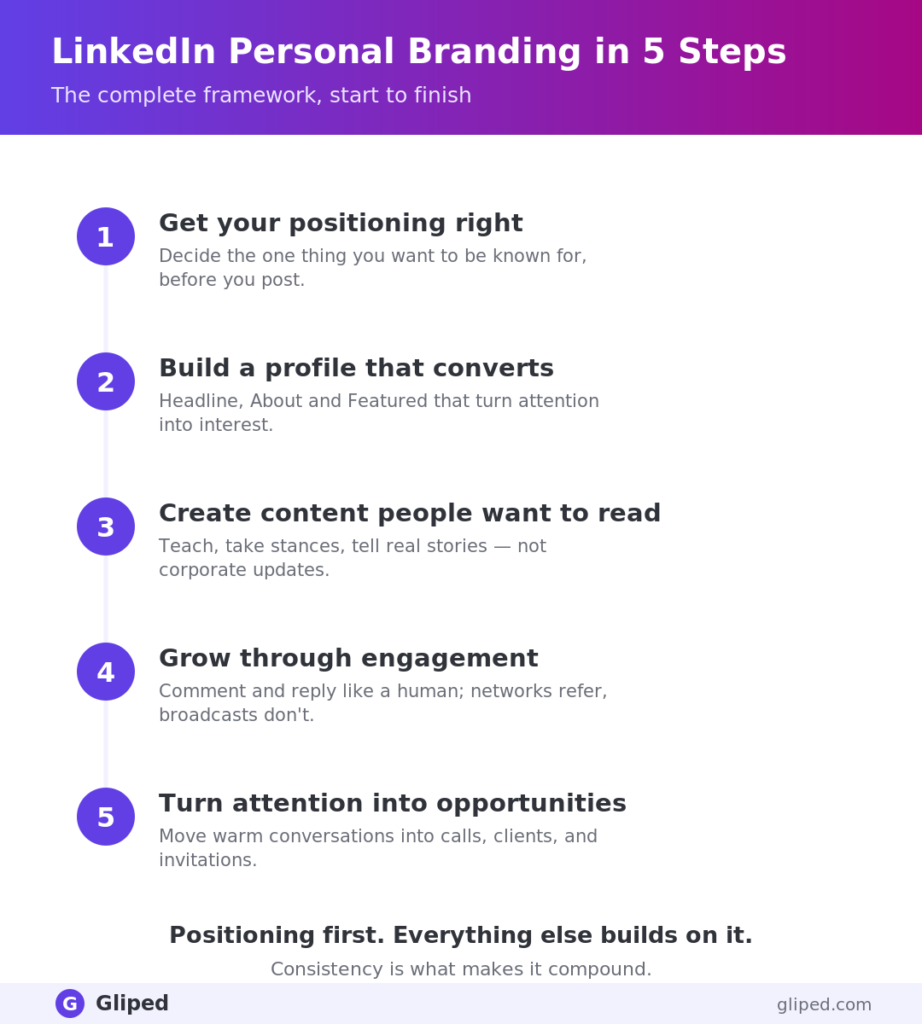
This is the complete guide. It walks through everything, in order:
- What personal branding actually is
- How to position yourself
- How to build a profile that converts
- How to create content people care about
- How to grow through engagement
- How to turn all of that attention into real opportunities.
Whether you’re a founder, a consultant, or a professional building toward your next move, you can work through it from top to bottom.
What LinkedIn personal branding really means
Personal branding gets a bad reputation because people assume it to be self-promotion, humble-bragging, and manufactured hustle. It’s none of that. Your personal brand is just the reputation you have when you’re not in the room — a set of things people reliably associate with your name. You already have one; the question is whether you’re actively shaping it or leaving it to happen for itself.
On LinkedIn specifically, a strong personal brand does three jobs.
- It makes the right people aware you exist.
- It builds enough trust that they take you seriously.
- It helps you stay top of mind, so that when anything related comes up, they think of you first.
Everything in this guide serves those three jobs.
Step 1: Get your positioning right before you post anything
The most common mistake is jumping straight to posting. Content without a clear positioning strategy fails to make an impact, so before you write a post, get clear on three things: who are your services for, what you help them achieve, and why they should choose you specifically. Positioning is the decision to be known for something specific rather than being vaguely visible to everyone.
A useful exercise: finish these sentences. “I help [a specific type of person] achieve [a specific outcome].” “People come to me when they need [a specific problem solved].” “What makes my perspective different is [your angle, experience, or belief].” Keeping your message focused and honest is how you build a strong brand. When you try to be everything to everyone, you blend right into the background.
Step 2: Build a profile that converts attention into interest
Your headline
The headline is the highest-leverage field on the platform — it appears everywhere and heavily influences search. Use the formula: who you help + the outcome you create + a credibility signal, and include four or five keywords your audience would search for. For a full breakdown and dozens of examples, read our complete guideline on LinkedIn headline examples.
Your photo and banner
Your about section
Featured, experience, and social proof
Step 3: Create content people actually want to read
What to write about
The strongest content sits where your expertise meets your audience’s problems. You can always pull your ideas from a few reliable sources:
- Lessons you’ve learned the hard way
- Common mistakes you see in your field
- Strong opinions you can defend
- Behind-the-scenes stories from your work
- Clear explanations of things your audience finds confusing.
- Personal stories with a professional point tend to travel furthest because they’re both relatable and useful.
How to make it perform
How often to post
Step 4: Grow through engagement, not just broadcasting
Posting is only half the game. LinkedIn is a network, and the people who grow fastest treat it like one. Spend time each day leaving thoughtful comments on posts from people in your space — not generic comments like “great post,” but genuine additions that show your thinking. Every good comment is a mini-post seen by a new audience, and it’s often how the right people first notice you.
Reply to every comment on your own posts as soon as you can because that early activity signals to the algorithm that your content is worth spreading. Answer your messages like a person, not a pitch. Over time, this steady, generous engagement builds the relationships that turn followers into clients, collaborators, and advocates.
Step 5: Turn attention into opportunities
A personal brand that doesn’t lead anywhere is a hobby. The point of reach and trust is to open doors — clients, roles, partnerships, speaking, hiring. The bridge between attention and opportunity is a clear, low-friction path to work with you or talk to you. Make sure your profile says what you offer and how to start. Occasionally, and without shame, tell your audience how you can help them. People can’t take you up on an offer you never make.
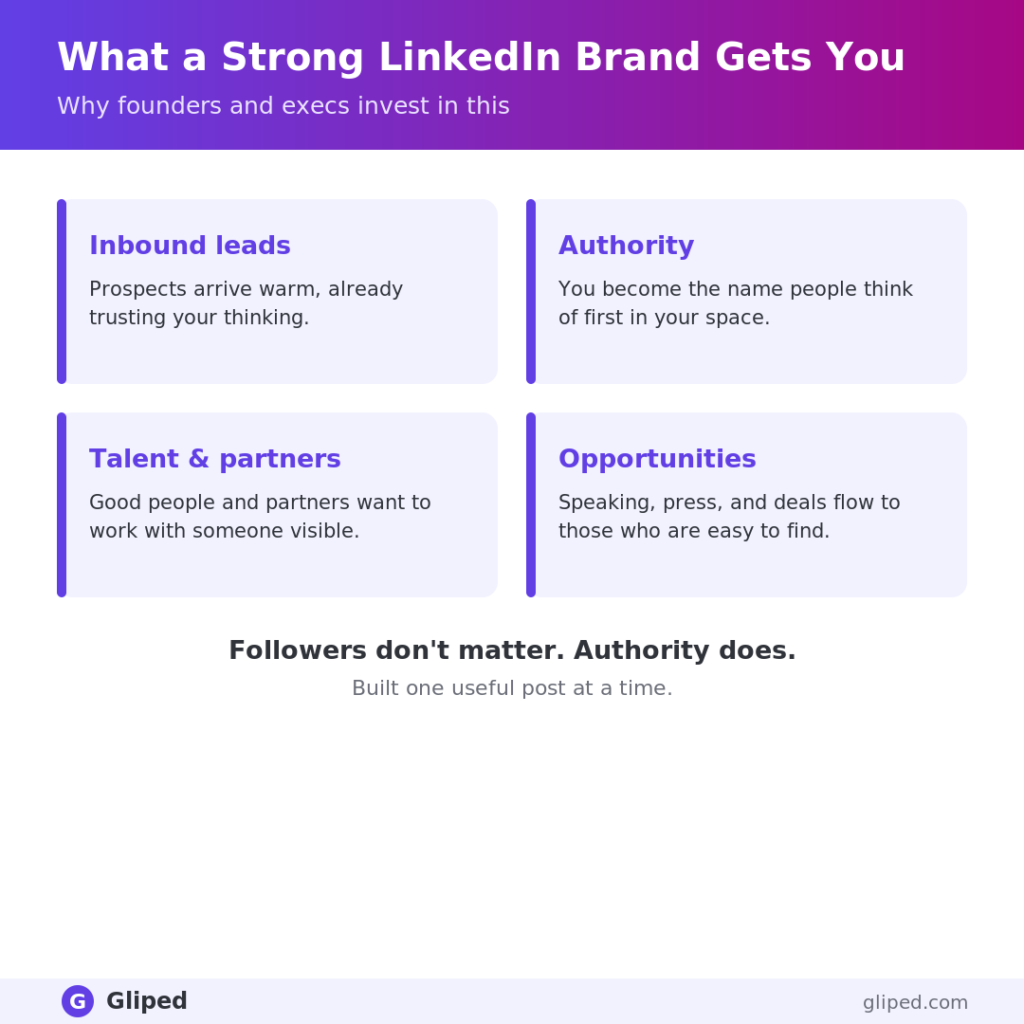
The compounding effect is the real reward. A profile optimized once keeps working. Content published today keeps being found tomorrow. Relationships built through engagement deepen over months. A year of consistent, well-positioned presence turns your name into an asset that generates inbound interest without you chasing it.
Should you do it yourself or get help?
Building a personal brand is entirely doable on your own — this guide gives you the full playbook. The honest challenge is not knowledge but consistency: most busy founders and executives know what to do and simply can’t sustain it alongside running a business. That’s the gap agencies and ghostwriters fill, capturing your thinking and turning it into a steady, strategic presence so the compounding never stalls. If you’re weighing that route, it helps to understand how LinkedIn ghostwriting works and what a personal branding agency actually costs before you decide.
Whichever path you choose, the principles don’t change. Get your positioning sharp, build a profile that converts, publish content worth reading, engage like a human, and give people a clear way to work with you. Do that consistently, and LinkedIn stops being a place you occasionally check and becomes one of the most valuable business assets you own.