
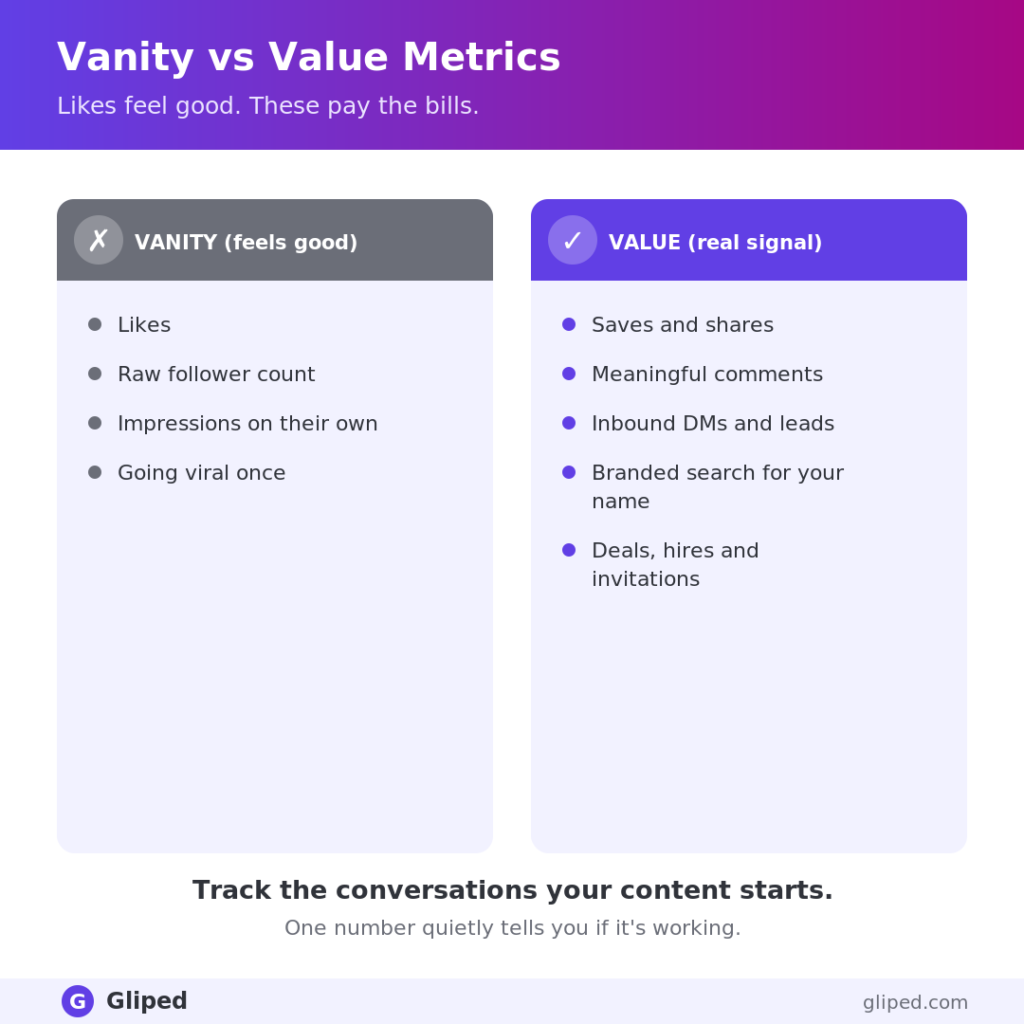
A post got 500 likes and your bank account didn’t move. Sound familiar? Most people measure their personal brand by the numbers that feel good, not the ones that mean anything. Likes are the sugar rush; the metrics that matter are quieter and slower — and they’re the ones that tell you whether this is working.
This updated guide separates vanity from value. It lays out the personal branding metrics and KPIs worth tracking in 2026, organised the way a founder actually thinks — from attention, to trust, to business outcomes — so you can tell the difference between busy and effective.
First, decide what your personal brand is for
You can’t measure success without defining it. A brand built to attract clients is measured differently from one built to hire talent, raise a round, or land speaking slots. Get specific about your goal, because it decides which numbers matter and which are just noise. Everything below ladders up to a business outcome — that’s the point.
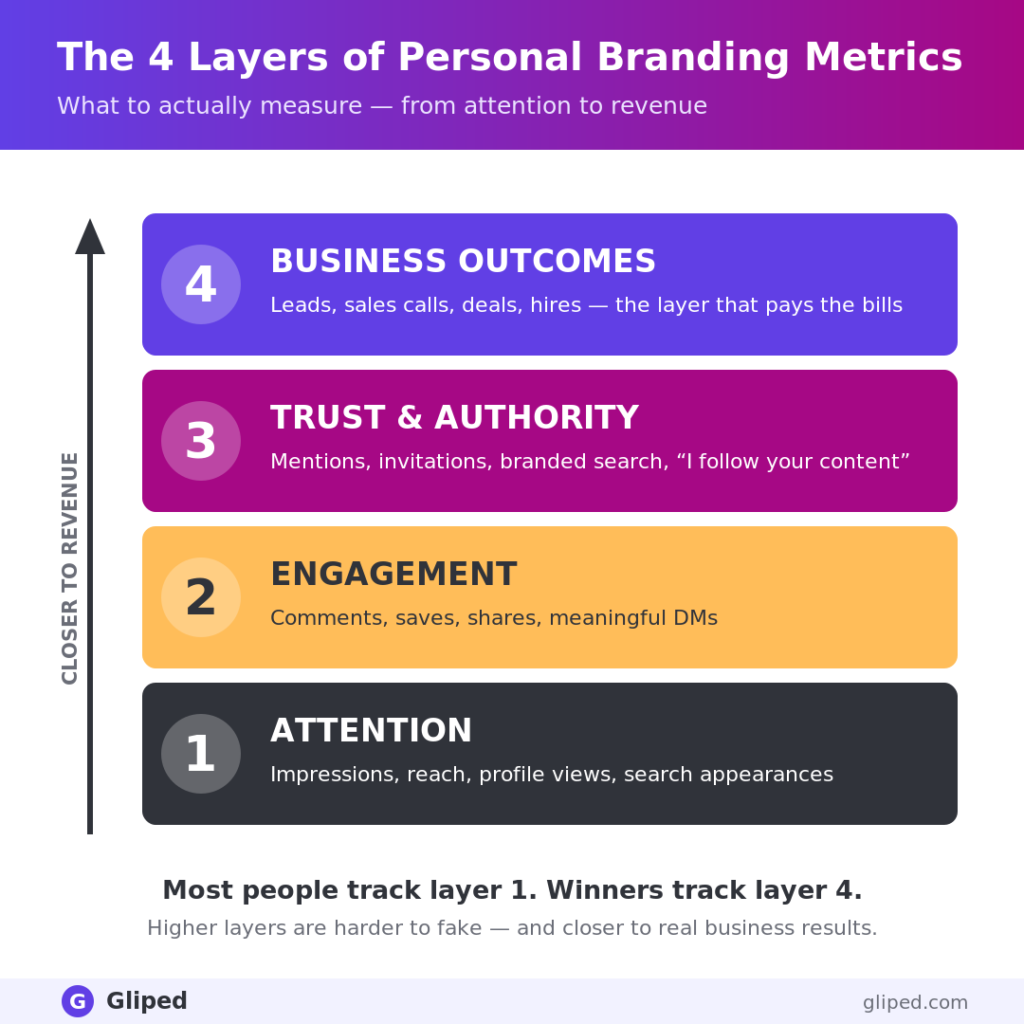
Layer 1: Attention metrics (are you being seen?)
These are the top of the funnel — necessary but not sufficient. They tell you whether your content is reaching people, not whether it’s changing minds. Watch the trend over weeks, not the number on any single post.
- Impressions and reach — the size of the audience seeing you, tracked as a trend.
- Profile views — a strong signal, because it means content made someone curious about you.
- Follower growth rate — less important than engagement, but useful directionally.
- Search appearances — how often you surface when people look for your topic.
Layer 2: Engagement metrics (do they care?)
This is where attention becomes interest. Engagement tells you the right people are responding, not just scrolling. Quality matters more than quantity here — one comment from an ideal client outweighs fifty likes from strangers.
- Comment quality and volume — real conversations beat emoji reactions.
- Saves and shares — the strongest content signal; people keep or spread what’s genuinely useful.
- Engagement rate — interactions relative to reach, so you’re not fooled by a big follower count.
- Meaningful DMs — replies that start a real conversation with the people you want to reach.
Layer 3: Trust and authority signals (are you the go-to?)
These are harder to put in a spreadsheet but they’re the real prize. They tell you your positioning is landing and your name now carries weight in your niche.
- Inbound mentions and tags — people bringing you into conversations unprompted.
- Invitations — podcasts, panels, collaborations, speaking slots arriving without you chasing them.
- Branded search — people googling your name specifically, a sign your reputation precedes you.
- “I’ve been following your content” — how often new conversations start warm.
Layer 4: Business outcomes (did it move the needle?)
This is the only layer that pays the bills, and the one most people never track back to their content. Connect the dots deliberately: when a lead arrives, ask how they found you. Over a quarter, the pattern becomes clear.
- Inbound leads and qualified enquiries attributable to your content.
- Sales-call requests and demo bookings that started on the platform.
- Deals closed where your personal brand shortened the trust-building.
- Opportunities beyond sales — hires, partnerships, investor interest, press.
How to actually track this without a data team
You don’t need fancy tooling. A simple monthly ritual beats a dashboard you never open: once a month, note your reach trend, your best-performing posts, any inbound that arrived, and where it came from. Ten minutes. The habit of looking is worth more than the precision of the numbers.
Set up the free basics — LinkedIn’s own analytics, plus Google Search Console and Google Analytics on your site — so you can see branded search and traffic from your content. Then review monthly and adjust.
The one number that matters most
If you track nothing else, track this: how many good conversations started because of your content this month. Not the likes. Conversations with prospects, partners, or people who can change your trajectory. That single number quietly captures whether the whole effort is working.
Vanity metrics make you feel productive. Business metrics tell you the truth. Which set have you been watching?
Where Gliped comes in
If tracking all of this feels like a lot, that’s usually where an agency earns its keep.
That’s what we do at Gliped. Founded by Prabal Lakhotiya — a LinkedIn Top Voice for personal branding — we’ve used these same organic strategies to help 200+ founders and executives and 15+ brands grow on LinkedIn, with most seeing real traction within two to three months. No ads and no follower-buying — just sharp positioning, content in your own voice, and the consistency that compounds. Along the way, we’ve worked with executives from companies like Meta, Amazon Web Services, McDonald’s, Marubeni, Piramal Finance, Education First, BT Group and Urbanic — helping the person behind the brand, not just the logo.
If you’d like this handled for you, see how we work at gliped.com or reach out for a quick, no-pressure chat — we’ll tell you honestly whether we’re the right fit.