
Having a personal brand used to make you stand out. Now, not having one makes you invisible. When a prospect, an investor, or a future hire hears your name, they type it into a search bar within minutes. What they find — or don’t — decides how the next conversation goes before you’ve said a word.
A personal brand is not a logo or a colour palette. It’s the reputation that arrives in the room before you do. This step-by-step guide, updated for 2026, shows how to build one deliberately so you become the authority people think of first in your industry.
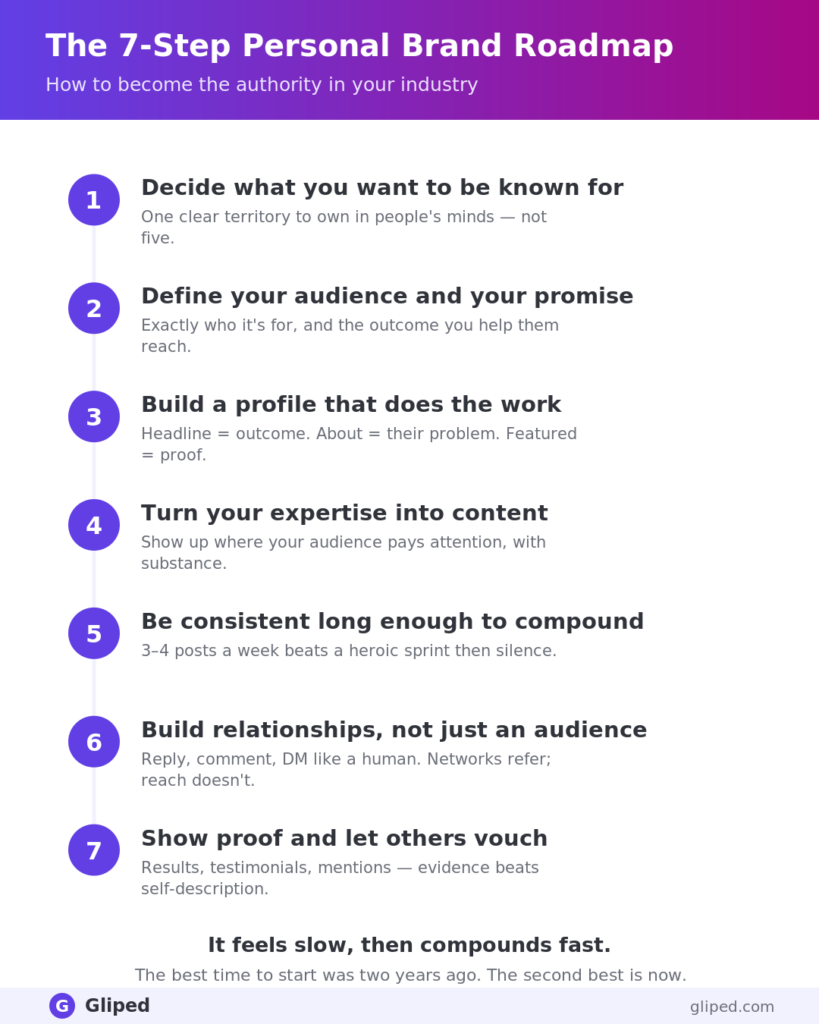
Step 1: Get clear on what you want to be known for
Everything starts with a decision most people skip: choosing your one thing. Not five things — one clear territory you want to own in people’s minds. This becomes the spine of your brand. Ask what problem you solve better than most, for whom, and why it matters. If your answer could belong to anyone in your field, keep cutting until it’s unmistakably yours.
Step 2: Define your audience and your promise
A brand without a specific audience is just noise. Decide exactly who you’re building this for — their role, their goals, the pressure they’re under — and what outcome you help them reach. Your promise is the bridge between the two. When your audience and promise are sharp, every later decision (what to post, what to ignore) gets easy.
- Who, specifically, do you want to attract — clients, talent, investors, peers?
- What tangible outcome do you help them achieve?
- What do you want them to feel and say about you?
Step 3: Build a profile that does the work
Your LinkedIn profile is your home base, and most people leave it half-built. The headline should lead with the outcome you create, not your title. The About section should open with the reader’s problem, then your approach and proof. Add a featured section with real work — case studies, talks, posts — so a first-time visitor sees evidence, not just claims. Treat it as a landing page, because that’s what it is.
Step 4: Turn your expertise into content
Authority is built in public, one useful post at a time. You don’t need to be everywhere — pick the platform where your audience actually pays attention (for most founders and executives, that’s LinkedIn) and show up there with substance. Share what you know, how you think, and what you’ve learned the hard way. The goal isn’t to go viral; it’s to be consistently useful to the right people.
- Teach real frameworks and specifics, not motivational filler.
- Tell stories from your actual work — clients, failures, decisions.
- Take clear positions; authority comes from conviction, not hedging.
Step 5: Be consistent long enough to compound
This is where most personal brands die — not from bad content, but from stopping too soon. The first month feels like shouting into a void. Then, quietly, it works: people start recognising your name, referencing your posts, tagging you when your topic comes up. Commit to a posting frequency you can sustain — three to four posts a week beats a heroic sprint followed by silence.
Step 6: Build relationships, not just an audience
A brand grows faster through people than through broadcasts. Reply to comments like a human. Comment thoughtfully on others’ work. Have real conversations in the DMs without pitching. The strongest personal brands feel like a network of relationships, not a megaphone — and networks refer, recommend, and open doors that reach never will.
Step 7: Show proof and let others vouch for you
Nothing builds authority like third-party evidence. Client results, testimonials, being quoted, being invited to speak — these say more than any self-description. Make proof a regular part of your content, not an afterthought. When other credible people say you’re the expert, you no longer have to.
The honest timeline
Building a personal brand that generates inbound is a matter of months, not weeks — but it’s the most durable asset you’ll build, because it follows you across jobs, companies, and ventures. The bar to start has never been lower, and the cost of staying invisible has never been higher.
Start with your one thing. Fix your profile this week. Post something useful tomorrow. Then keep going long enough for the market to catch up. The best time to have started was two years ago. The second best time is now — and you already know that.
Where Gliped comes in
This roadmap works, but only if someone actually walks it, week after week.
That’s what we do at Gliped. Founded by Prabal Lakhotiya — a LinkedIn Top Voice for personal branding — we’ve used these same organic strategies to help 200+ founders and executives and 15+ brands grow on LinkedIn, with most seeing real traction within two to three months. No ads and no follower-buying — just sharp positioning, content in your own voice, and the consistency that compounds. Along the way, we’ve worked with executives from companies like Meta, Amazon Web Services, McDonald’s, Marubeni, Piramal Finance, Education First, BT Group and Urbanic — helping the person behind the brand, not just the logo.
If you’d like this handled for you, see how we work at gliped.com or reach out for a quick, no-pressure chat — we’ll tell you honestly whether we’re the right fit.