
Being the best-kept secret in your field is not a flex. Plenty of genuinely excellent people stay invisible while someone with half the expertise gets the calls, the clients, and the stage — because they’re known for one clear thing, and you’re known for being “good at a lot of stuff.”
Positioning fixes that. It’s the deliberate choice to be the obvious answer to a specific question in a specific person’s mind. This updated guide walks through exactly how to do it in 2026, when someone is already searching for precisely what you do — the only question is whether they find you or your competitor.
Positioning is a decision, not a description
Most people treat positioning like a bio: a list of everything they can do. Real positioning is subtraction. It’s choosing what you want to be known for and being willing to let go of the rest — at least publicly. The narrower the claim, the stronger the pull.
“Marketing consultant” competes with a million people. “I help B2B SaaS founders turn LinkedIn into a pipeline channel” competes with almost no one — and it tells the right person they’re in the right place.
Pick a niche you can own, not just enter
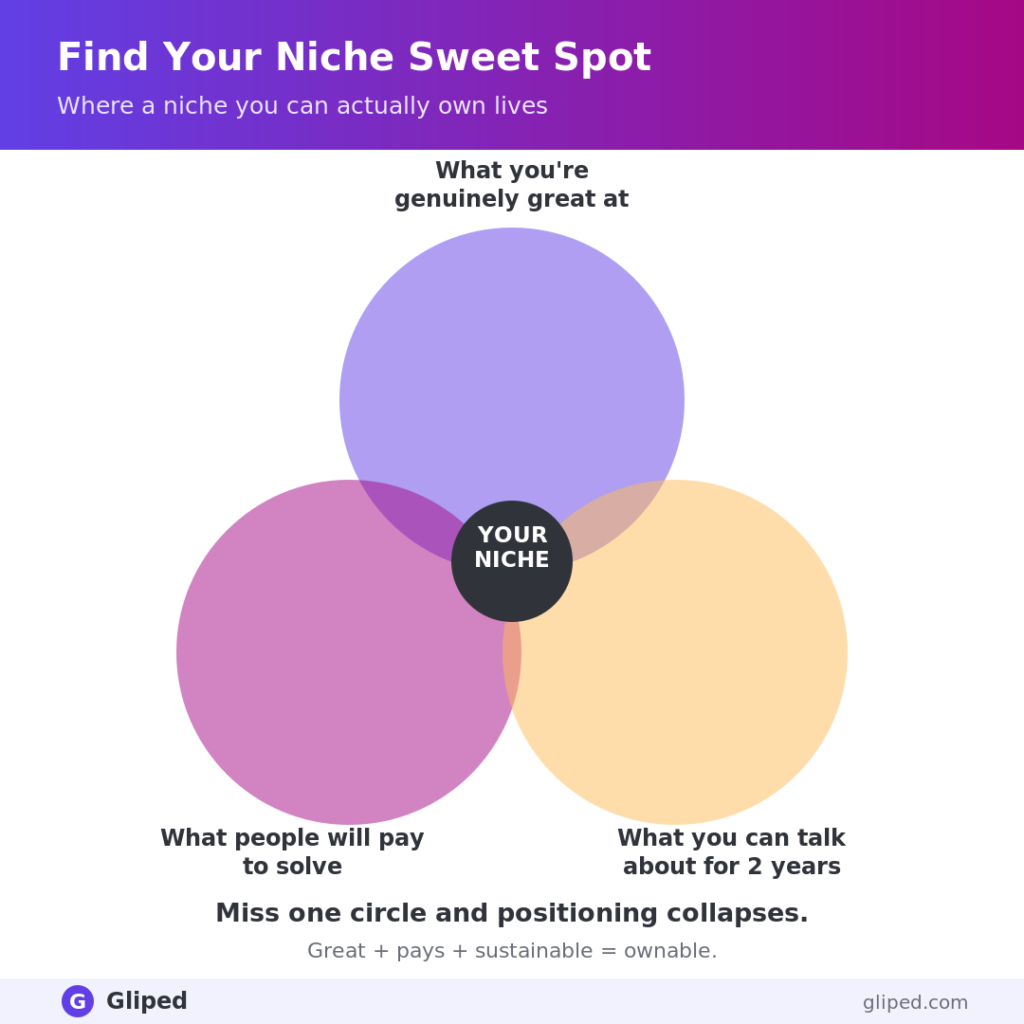
A good niche sits at the intersection of three things: what you’re genuinely great at, what a specific group will pay to solve, and what you can talk about for years without getting bored. Miss any one and positioning collapses — you’ll either sound generic, chase a market that doesn’t buy, or burn out on your own topic.
- Where does your expertise create outsized results others struggle to get?
- Which specific group feels that problem sharply enough to pay for a fix?
- Can you happily create content on this for the next two years?
Write the one sentence everything hangs on
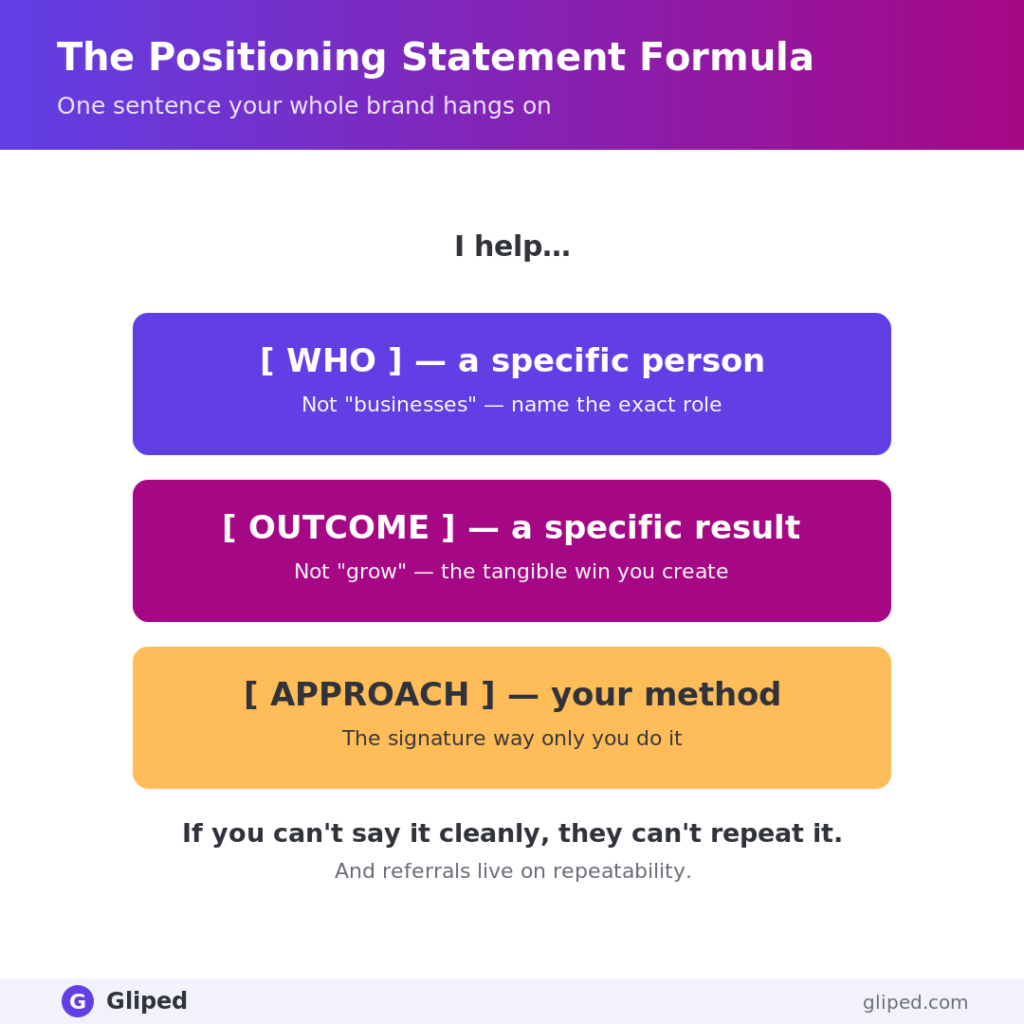
Before you post anything, nail your positioning statement: I help [specific person] achieve [specific outcome] through [your approach]. This one line drives your headline, your About section, your content topics, and your pitch. If you can’t say it cleanly, your audience can’t repeat it, and referrals live on repeatability.
Make your profile agree with your positioning
Your LinkedIn profile is where positioning becomes visible. The headline should state the outcome, not the job title. The About section should open with the problem you solve, not your career history. The featured section should show proof. When a stranger lands on your profile, they should understand what you’re known for in under ten seconds.
Prove it with content, repeatedly
You don’t become the expert by claiming it — you become the expert by teaching it, publicly, over and over. Pick the handful of ideas central to your niche and return to them from different angles: a story, a framework, a myth you bust, a client result. Repetition isn’t boring to your audience; it’s how positioning sinks in. Most people see your post once, not ten times.
- Teach the how, not just the what — specifics signal real expertise.
- Take clear stances; experts have opinions, not disclaimers.
- Use real examples and numbers instead of vague advice.
Show your work, not just your wins
Authority in 2026 comes from transparency as much as results. Share the reasoning behind your decisions, the mistakes you learned from, the behind-the-scenes of how you actually work. It’s counter-intuitive, but the person who explains why they were wrong last year reads as more credible than the one who only posts trophies.
Borrow authority until you build your own
Early on, proximity to trust accelerates yours. A conversation with a respected name in your field, a guest slot on a relevant podcast, a thoughtful comment that a known founder replies to — each one tells your audience “this person belongs in that room.” Don’t wait to be invited; add enough value that inviting you becomes obvious.
Give it time — positioning compounds
Expertise perception is a slow build that suddenly looks fast. For months it feels like nothing’s happening; then people start introducing you as “the LinkedIn person” or “the one who does X,” and inbound arrives. The founders who win are simply the ones who stayed narrow and consistent long enough for the label to stick.
So decide what you want to be known for — then say it, prove it, and repeat it until the market says it back to you. Someone is already searching for exactly what you do. Will they find you?
Where Gliped comes in
Positioning yourself as the expert takes clarity, and a consistency most people can’t sustain alone.
That’s what we do at Gliped. Founded by Prabal Lakhotiya — a LinkedIn Top Voice for personal branding — we’ve used these same organic strategies to help 200+ founders and executives and 15+ brands grow on LinkedIn, with most seeing real traction within two to three months. No ads and no follower-buying — just sharp positioning, content in your own voice, and the consistency that compounds. Along the way, we’ve worked with executives from companies like Meta, Amazon Web Services, McDonald’s, Marubeni, Piramal Finance, Education First, BT Group and Urbanic — helping the person behind the brand, not just the logo.
If you’d like this handled for you, see how we work at gliped.com or reach out for a quick, no-pressure chat — we’ll tell you honestly whether we’re the right fit.